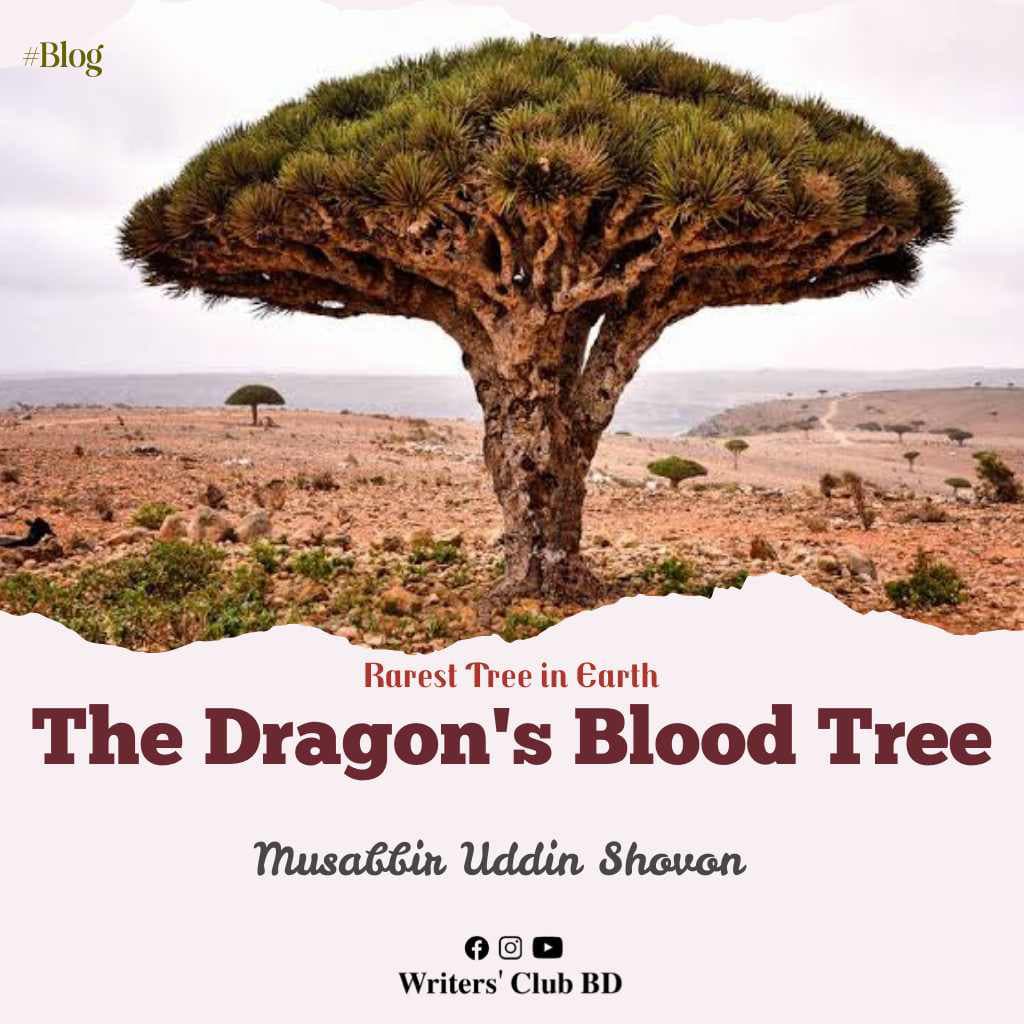
The dragon's blood tree is a dragon tree native to the Socotra archipelago, part of Yemen, located in the Arabian Sea. It is named after the blood like color of the red sap that tree produce. It is considered the national tree of Yemen just like Mango tree is considered the national tree of Bangladesh. The scientific name is Dracaena cinnabari.
Flourishing in harsh desert climate, dragon tree have been stepped in myth long time ago. Indian, Greek and Arabian culture believed this tree, with its umbrella shaped crown & spiny leaves bleed the blood of dragons. Since antiquity, people have sought the sap for its supposed medicinal and magical properties.
In Hindu myth, the gods Brahma and Shiva fought in the form of a dragon and elephant respectively. The dragon bit the elephant and drank its blood. After that elephant crushed the dragon & their blood mixed to form this tree's red sap.
In Arabian myth, the dragon tree originated where two brothers, Darsa and Samha fought each other. There are lots of myth about the dragon's blood tree.
Dragon's blood tree has some medical ingredients that helps to cure many disease included skin ulcer and diarrhoea.
The plant resin was formerly prescribed cure-all properties. Moreover it was once thought to speed wound healing and some physician and healer used it for respiratory issue. It was also helped for different gastrointestinal conditions for example diarrhoea, dysentery, pancreatitis etc.
Dragon's blood tree also used as antimicrobials benefits. Research about this tree showed that the growth of microorganisms was inhibited because of the phenolic compound in dragon's blood resin.
Dragon's blood resin is rich in flavonoids. These naturally occurring plant compounds hold anti oxidant qualities and help body scavenge cell damaging free radical which can threaten to our health.
Anti oxidant are helpful for skin health as they protect from UV(Ultra Violet Light) damage and skin inflammation.
All plant resins have the potential to be irritating to the skin. In some cases, irritant contact dermatitis may occur after contact with dragon's blood powder or dragon's blood resin.
Skin creams containing dragon's blood have
been dermatologically tested for tolerance and are far less concentrated than the pure version This means they are less likely to cause reaction, although reactions are still possible.
It is now about to extinct in our planet because loss of their habitats to ranching and farming. Changing climate that is drier than in previous years, with shorter periods of low-lying clouds and mist, is causing
some dragon trees to stop flourishing in
their original habitats. However, the tree is
widely cultivated; and although it is slow
growing. So, International Union for Conservation of Nature categorise this tree as a red list of a Threatened species in the world. So, it is considered one of the rarest tree in this planet.
Content Writer: S. M. M. MUSABBIR UDDIN
Poster Designer: Summiya Islam Sinthia